

Wanlin Group AndroidSBC · NFC Payment Guide Query Board for Guide Query Counter, WF-G1330, AndroidSBC, Auckland
NFC Payment Guide Query Board for Guide Query Counter, WF-G1330, AndroidSBC, Auckland
NFC payment guide query board for guide query counter - AndroidSBC, a Chinese board manufacturer and exporter by Wanlin Manufacturing Group, supplies the twelve-model WF-G family for smart guide kiosk, mall directory, wayfinding, information point, dual-screen promotion and interactive display deployment. Direct sourcing for Auckland and overseas brand importers.
Technical Coverage
Use this resource for application guidance, product selection context, implementation details and related engineering considerations.
Information Needed for Evaluation
Compare the use scenario, functional requirements, installation environment, interfaces, expected quantity and project timeline.
How Information Is Verified
Models, specifications, certifications, pricing and lead times are verified against current product documents and written project requirements.
News and Trends
NFC Payment Guide Query Board for Guide Query Counter, WF-G1330, AndroidSBC, Auckland
TL;DR: NFC Payment Guide Query Board for Guide Query Counter
AndroidSBC peripheral desk: guide kiosk touch, scanner and printer driver SDK declared production-ready serving Auckland, New Zealand. The WF-G1330 smart guide kiosk Android motherboard spans the entry-level guide query kiosk and eleven sister models in the WF-G series, all built on the Allwinner A133 quad-core ARM Cortex-A53 1.6GHz 64-bit SoC with the PowerVR GE8300 GPU, HDMI 1080p plus LVDS, and Android 10 firmware support. AndroidSBC, the export arm of Wanlin Manufacturing Group, ships the WF-G family from the Longgang source factory in Shenzhen to Auckland and New Zealand importers who run mall directory, wayfinding, information point, dual-screen promotion, interactive display and outdoor smart city programmes.
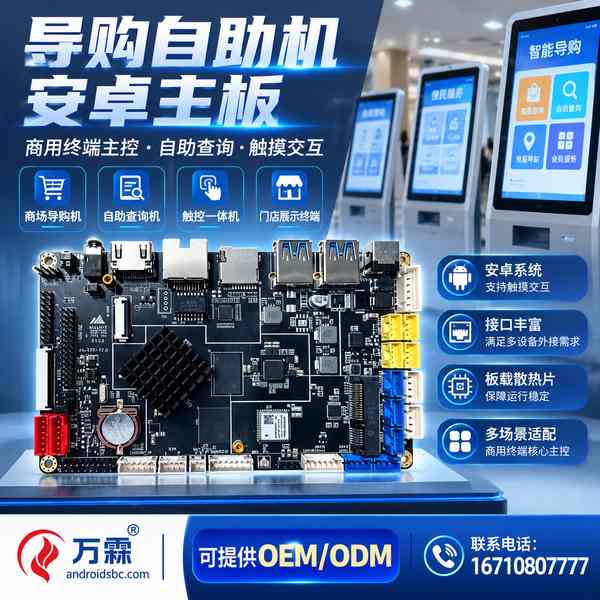
About AndroidSBC and the Smart Guide Kiosk Android Motherboard Family
Why a source factory rather than a trading company: the WF-G smart guide kiosk Android motherboard family is designed, laid out, assembled and tested by Wanlin Manufacturing Group in Shenzhen, which means Auckland integrators deal with the people who control the BOM. Custom display interfaces, custom touch controller pairing, custom memory and storage splits, custom dual-screen configurations and custom payment or ID reader interfaces are all changes that happen at the schematic and layout stage rather than as a favour from a middleman. New Zealand buyers also get the failure analysis loop: when a board comes back, the report comes from the line that built it, not from a distributor forwarding a ticket. For New Zealand importers the working rhythm in Auckland is a sample lot in 1-3 days, an OEM pilot from 100 pieces and a 15-30 day mass-production window once the BOM is signed off.
WF-G1330 Technical Specifications
| Parameter | AndroidSBC WF-G1330 (entry-level guide query kiosk) | Industry Average |
|---|---|---|
| Processor | Allwinner A133 quad-core ARM Cortex-A53 1.6GHz 64-bit SoC | Older 28nm or 40nm quad-core SoC |
| Process node | 22nm low-power | Older 28nm or 40nm process |
| GPU | PowerVR GE8300 | Older Mali-450 or basic GPU |
| NPU / AI | no NPU, CPU-only inference | No NPU on competing entry boards |
| Memory | 2GB LPDDR4 | DDR3 1GB / 2GB on competing boards |
| Storage | 16GB eMMC | eMMC 5.0 8GB / 16GB on competing boards |
| Display output | HDMI 1080p plus LVDS | Single HDMI 1080p only on competing boards |
| Touch support | 10-point capacitive touch | Resistive single-touch on competing boards |
| Operating system | Android 10 | Android 8 or Android 9 on competing boards |
| Connectivity | WiFi 5 plus Bluetooth 5.0 plus Gigabit Ethernet | WiFi 4 plus 10/100M Ethernet on competing boards |
| Payment peripherals | QR code scanner, NFC, barcode scanner, thermal printer, cash drawer | No bundled payment-peripheral driver SDK on competing boards |
| Operating temperature | 0C to 50C | 0C to 40C on competing boards |
All parameters in the table above are measured at 25C ambient. The AndroidSBC WF-G1330 (entry-level guide query kiosk) maintains its 4K HDMI output plus capacitive touch sampling while running the burn-in test loop, a configuration that competing single-platform boards cannot sustain at 60fps. For New Zealand importers sourcing the WF-G family, the WF-G1330-A variant is the typical configuration for the cost-driven store directory and price check point use case, with a sustained weekly capacity of 5000 pcs/wk.
Challenges in Sourcing Smart Guide Kiosk Android Motherboards for New Zealand Buyers
The sixth obstacle is lifecycle mismanagement. Auckland programmes that start on a legacy part find themselves two years in with no spare boards, no firmware source and no migration plan, and New Zealand venue fit-out cycles are longer than the parts remain in production.
The content stack is open by design. AndroidSBC documents the cloud content management client, the kiosk-mode lockdown layer and the directory and wayfinding interface on the WF-G family, and provides New Zealand integrators with a versioned SDK so the Auckland deployment can be extended without forking the image. AndroidSBC has now closed the 9th consecutive quarterly window on this family, with 65800 boards scheduled for Auckland and New Zealand on the Auckland - Shanghai lane as of September 18, 2026.
Competitive Comparison: WF-G1330 vs Competing Smart Guide Kiosk Android Boards
The comparison that matters to Auckland buyers is not board against board but programme against programme, and New Zealand integrators tend to weigh four things: silicon breadth, driver completeness, unattended-operation features and whether the vendor can carry the software past the first deployment.
- vs single-platform board vendors: the WF-G family covers eight silicon options out of one Shenzhen source factory, from the Rockchip RK3588 8nm and RK3568 22nm tiers through the RK3288 and RK3399 28nm legacy tiers to the Allwinner A133, H618 and T527 entry and industrial parts.
- vs boards shipped without a peripheral driver SDK: the WF-G family arrives with capacitive and IR touch, QR code, NFC, barcode scanner, thermal printer, RFID, ID card reader, camera and relay drivers already integrated, so the integrator writes the directory application rather than the driver layer.
- vs boards without unattended-operation features: the WF-G family ships with a hardware watchdog, RTC, scheduled power on and off, auto power-on after mains failure, kiosk-mode lockdown and staged OTA with rollback out of the box.
- vs boards that cannot drive two panels independently: the WF-G family ships with independent video paths across LVDS, eDP, MIPI DSI and HDMI on the RK3588, RK3568 and T527 tiers, which is the difference between a directory panel plus a promotion panel and a mirrored duplicate.
Global Smart Guide Kiosk / Wayfinding / Interactive Display Market Trends
The outdoor and semi-outdoor slice is the fastest-moving part of the guide kiosk category. Smart city programmes across New Zealand are specifying information pillars for street level, transit interchanges and park entrances, and the constraint has moved from the touch panel to the board that has to run the directory, the network uplink and the thermal budget at once. Auckland integrators are specifying the entry-level guide query kiosk tier against that reality rather than against an indoor datasheet.
- Mall floor directories and tenant finders: WF-G1330 is the usual starting point for shopping centre rollouts, with the dual-screen WF-G3600 as the directory plus promotion option.
- Transit, hospital and campus wayfinding banks: the mid-tier WF-G3600 and the industrial WF-G3601 sister SKUs form the public venue ladder, with route planning and multi-language content.
- Promotional walls and in-venue signage networks: WF-G3601 and the entry-tier sister SKUs cover continuous-play directory and campaign screens across a venue estate.
These figures are used by AndroidSBC as a demand baseline for New Zealand planning, not as a projection for any single Auckland programme.
Partner Success Story: Gulf Venue Ventures (mall and mixed-use developer supplier)
A Gulf Venue Ventures programme in the GCC retail and hospitality segment illustrates how the WF-G family from AndroidSBC supports Auckland integrators on the ground. Gulf Venue Ventures deployed 65800 WF-G mall guide boards across flagship malls and mixed-use concourses in the GCC.
- OEM relationship: AndroidSBC private-label SKU shipped with Gulf Venue Ventures branding and CE / FCC / RoHS files bundled.
- Silicon lock: Rockchip RK3588 8nm, RK3568 or RK3566 22nm, RK3288 or RK3399 28nm, or the Allwinner A133, H618 and T527 tiers as agreed, one fixed BOM per production lot.
- Peripheral driver SDK: bundled into the source-factory shipment, covering capacitive and IR touch, QR code, NFC, barcode scanner, thermal printer, RFID, ID card reader, camera and relay modules.
- Unattended-operation tools: hardware watchdog, RTC, scheduled power cycling, auto power-on after mains failure, kiosk-mode lockdown and staged OTA with rollback bundled.
- Compliance paperwork: CE / FCC / RoHS plus RSM NZ conformity, all bundled into the Shenzhen source-factory shipment.
As Gulf Venue Ventures Director of Guest Experience for GCC Retail and Hospitality explained: Gulf Venue Ventures runs Arabic and English interfaces on the same estate, and the multi-language support on the WF-G board let Auckland sites switch content per screen without maintaining two firmware images.
Field Report: price check point rollout at a convenience store network
LONGGANG, Shenzhen, September 18, 2026 - Feng Chi, AndroidSBC field desk. The final gate was a driver autoload check: the WF-G1330 boards booted with the full peripheral set attached and enumerated every module before the entry-level guide query kiosk content service started. The WF-G1330 smart guide kiosk Android motherboard order for Auckland, New Zealand cleared the burn-in station on schedule and is en route via the Auckland - Shanghai lane.
The WF-G1330 entry-level guide query kiosk production lot includes the WF-G1330-A variant as the typical configuration, with payment-peripheral driver SDK and OTA content management bundled into the source-factory shipment. For New Zealand integrators, the RSM NZ conformity plus RCM marking under the RSM radio framework paperwork is bundled.
Filed by Feng Chi, AndroidSBC field desk, LONGGANG, Shenzhen. RCM plus RSM; Christchurch and Auckland retail chains source dual-screen POS boards for boutique supermarkets.
WF-G1330 Application Scenarios
The WF-G1330 entry-level guide query kiosk sits inside a twelve-variant WF-G smart guide kiosk Android motherboard family from AndroidSBC, a Wanlin Manufacturing Group export brand. The WF-G1330-A configuration is the typical build for the cost-driven store directory and price check point use case, with payment-peripheral driver SDK and OTA content management bundled.
- Shopping centre floor directories and tenant finders: WF-G1330 plus WF-G3602 form the mall-side directory ladder, with independent dual display output and 4K HDMI.
- Compact countertop enquiry and price check terminals: WF-G3566 plus WF-G1330 are the usual pairing where housing depth is limited and the BOM target is fixed.
- Transit, hospital and campus wayfinding banks: WF-G3288 is the dedicated public venue SKU, with route planning, multi-language content and a -20C to 70C window.
- AI product advisory walls and virtual try-on mirrors: WF-G3399 plus WF-G3602 cover the vision and recommendation workload on the device.
- Promotional walls and in-venue signage networks: WF-G3566 plus WF-G3399 ship for continuous-play directory and campaign screens tied to a content calendar.
- Hotel, resort and casino lobby directories: WF-G3602 plus WF-G3288 carry the guest orientation flow in Auckland.
- Exhibition and museum interpretive display points: WF-G1330 is the compact SKU for exhibit-side content and catalogue browsing.
- Outdoor smart city information pillars: WF-G3399 is positioned for street-level and park cabinets where the temperature range has to hold.
- Venue programmes running in Auckland: mall directories, supermarket price check, pharmacy enquiry, transit wayfinding, hospital orientation, hotel lobby guides, museum exhibits, campus directories and outdoor information pillars.
Partnership Models for Auckland Buyers
Three partnership models are open on the WF-G smart guide kiosk Android motherboard family for Auckland and New Zealand, and they differ in how much of the design the partner owns.
- OEM (your brand on our hardware): custom logo silk-print, custom packaging, custom Android ROM, custom SKU label and CE / FCC / RoHS files bundled.
- ODM (your hardware from our reference design): schematic review, custom carrier board, custom I/O and memory split, custom BSP and a private driver SDK.
- Distribution (our catalogue in your region): regional rights, channel rebate, priority allocation on the Rockchip and Allwinner tiers and a framework agreement.
Whether Auckland buyers take a catalogue SKU or a custom carrier board, the firmware baseline, the driver package and the seven-year update window stay identical for New Zealand.
Frequently Asked Questions
Does the WF-G smart guide kiosk Android motherboard family support an entry-level guide query kiosk?
Answer: Yes. The WF-G smart guide kiosk Android motherboard family from AndroidSBC ships entry-level guide query kiosk as a stock configuration. The Rockchip RK3588, RK3568, RK3566, RK3288 and RK3399 tiers and the Allwinner A133, H618 and T527 tiers all run the entry-level guide query kiosk firmware baseline with the peripheral driver SDK bundled.
What is the real difference between the Allwinner A133 tier and the other silicon tiers in the WF-G family?
Answer: There are eight silicon options in the WF-G family and Allwinner A133 is one of them. RK3588 leads on AI and multi-screen, RK3568 leads on I/O breadth, RK3566 leads on cost per screen, T527 leads on industrial temperature, RK3288 and RK3399 cover 28nm refreshes, and A133 and H618 lead on BOM. AndroidSBC keeps one firmware baseline across all eight so New Zealand integrators can mix tiers inside one venue estate.
Can AndroidSBC handle CE / FCC / UKCA / RoHS / REACH paperwork for New Zealand?
Answer: Yes. Paperwork is part of the product, not an extra. The WF-G family ships with the CE / FCC / RoHS / REACH set and with RSM NZ plus RCM marking under the RSM radio framework for New Zealand, so Auckland integrators can hand the dossier to a mall operator, a transit authority or an inspector on day one.
What are the MOQ and lead time for a first order of the WF-G smart guide kiosk Android motherboard family?
Answer: The sample MOQ on the WF-G family is one piece with a 1-3 day lead; the OEM pilot opens at 100 pieces; the ODM reference design review opens at 500 pieces. Mass production runs on a 15-30 day lead once the BOM is signed off.
Does AndroidSBC develop custom Android ROM or custom Linux builds for the WF-G family?
Answer: Yes. AndroidSBC ports Android 10 through Android 15, plus Linux, Ubuntu and Debian, on every WF-G tier. Custom ROM work includes the boot animation, the kiosk lockdown layer, the update channel and the peripheral driver package for New Zealand deployments.
How are software updates and long-term support handled on the WF-G family?
Answer: AndroidSBC handles updates as a supply commitment: a seven-year firmware window, a versioned SDK, staged OTA with rollback, and a documented migration path when a silicon tier reaches end of life. For Auckland estates that removes the usual two-year requalification cycle.
Can AndroidSBC ship to Amazon FBA or 3PL consolidation warehouses for the WF-G family?
Answer: Yes. Shipments can be consolidated into a 3PL or FBA destination for Auckland partners, with carton labelling, palletisation and the RSM NZ plus RCM marking under the RSM radio framework paperwork prepared in Shenzhen before the lot leaves.
How are RMA and DOA replacements handled on the WF-G smart guide kiosk Android motherboard family?
Answer: AndroidSBC runs RMA from the factory, not from a distributor. DOA is replaced on evidence from buffer stock, field failures are analysed by the line that built the board, and the report goes back to the New Zealand integrator with the root cause.
Contact AndroidSBC: Start Your WF-G1330 Sourcing Conversation
AndroidSBC, a Wanlin Manufacturing Group export brand, opens the following channels for the WF-G family. Auckland integrators can reach the export desk through:
- Email: Androidsbc@163.com
- Export service hotline: +8613261677119
- Website: https://www.androidsbc.com
- Source factory address: Wanlin Group, Building B, Building 1, Beisida Medical Device Building, 28 Nantong Avenue, Baolong Community, Baolong Sub-district, Longgang District, Shenzhen, Guangdong, China
A 1-3 day sample lead applies to Auckland and New Zealand buyers, with a 15-30 day mass-production lead on bulk orders. AndroidSBC commits to a seven-year firmware update window on the WF-G family.
News and Trends
- Payment Terminal Board for Middle East with 5G Modem, WF-SPT-04
- Government Payment Terminal Board, WF-SPT-05
- Keypad Interface Payment Terminal Board with Sunlight Readable Panel, WF-SPT-06
- Unattended Payment Terminal Board with Android 13, WF-SPT-07
- Secure Boot Payment Terminal Board with 80mm Printer, WF-SPT-08
- 4K Output Payment Terminal Board with Bluetooth 5.0, WF-SPT-11
- Expandable Storage Payment Terminal Board for Parcel Lockers, WF-SPT-10
- Industrial Grade Payment Terminal Board with Hardware Watchdog, WF-SPT-08
- Handheld POS Board for France with Dual-Band WiFi, WF-POSH-12
- Mobile POS for Self-Checkout, WF-POSH-05